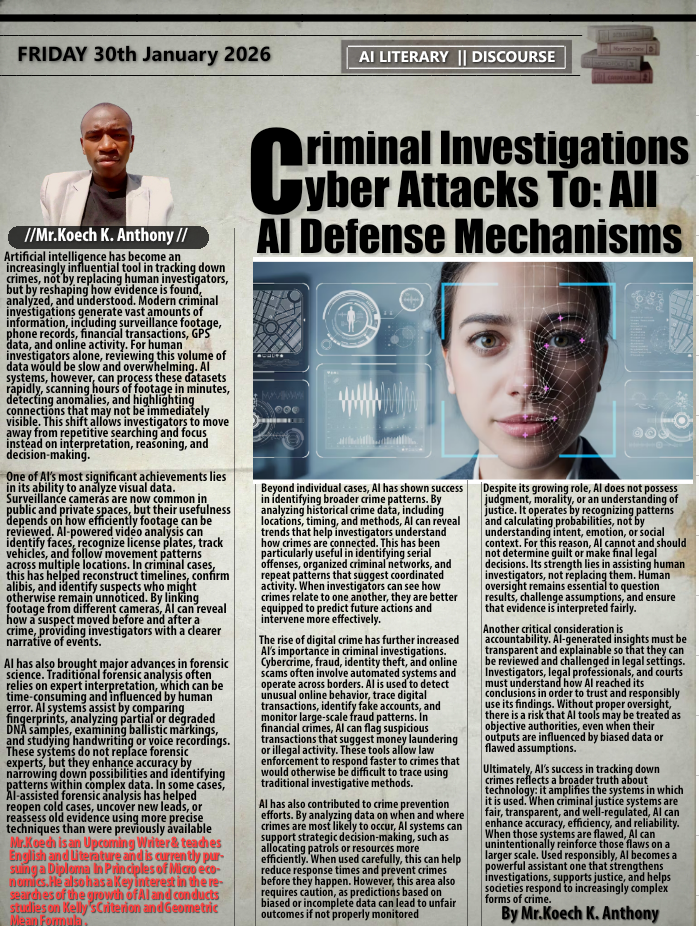
Artificial intelligence has become an increasingly influential tool in tracking down crimes, not by replacing human investigators, but by reshaping how evidence is found, analyzed, and understood. Modern criminal investigations generate vast amounts of information, including surveillance footage, phone records, financial transactions, GPS data, and online activity. For human investigators alone, reviewing this volume of data would be slow and overwhelming. AI systems, however, can process these datasets rapidly, scanning hours of footage in minutes, detecting anomalies, and highlighting connections that may not be immediately visible. This shift allows investigators to move away from repetitive searching and focus instead on interpretation, reasoning, and decision-making.
One of AI’s most significant achievements lies in its ability to analyze visual data. Surveillance cameras are now common in public and private spaces, but their usefulness depends on how efficiently footage can be reviewed. AI-powered video analysis can identify faces, recognize license plates, track vehicles, and follow movement patterns across multiple locations. In criminal cases, this has helped reconstruct timelines, confirm alibis, and identify suspects who might otherwise remain unnoticed. By linking footage from different cameras, AI can reveal how a suspect moved before and after a crime, providing investigators with a clearer narrative of events.
AI has also brought major advances in forensic science. Traditional forensic analysis often relies on expert interpretation, which can be time-consuming and influenced by human error. AI systems assist by comparing fingerprints, analyzing partial or degraded DNA samples, examining ballistic markings, and studying handwriting or voice recordings. These systems do not replace forensic experts, but they enhance accuracy by narrowing down possibilities and identifying patterns within complex data. In some cases, AI-assisted forensic analysis has helped reopen cold cases, uncover new leads, or reassess old evidence using more precise techniques than were previously available.
Beyond individual cases, AI has shown success in identifying broader crime patterns. By analyzing historical crime data, including locations, timing, and methods, AI can reveal trends that help investigators understand how crimes are connected. This has been particularly useful in identifying serial offenses, organized criminal networks, and repeat patterns that suggest coordinated activity. When investigators can see how crimes relate to one another, they are better equipped to predict future actions and intervene more effectively.
The rise of digital crime has further increased AI’s importance in criminal investigations. Cybercrime, fraud, identity theft, and online scams often involve automated systems and operate across borders. AI is used to detect unusual online behavior, trace digital transactions, identify fake accounts, and monitor large-scale fraud patterns. In financial crimes, AI can flag suspicious transactions that suggest money laundering or illegal activity. These tools allow law enforcement to respond faster to crimes that would otherwise be difficult to trace using traditional investigative methods.
AI has also contributed to crime prevention efforts. By analyzing data on when and where crimes are most likely to occur, AI systems can support strategic decision-making, such as allocating patrols or resources more efficiently. When used carefully, this can help reduce response times and prevent crimes before they happen. However, this area also requires caution, as predictions based on biased or incomplete data can lead to unfair outcomes if not properly monitored.
Despite its growing role, AI does not possess judgment, morality, or an understanding of justice. It operates by recognizing patterns and calculating probabilities, not by understanding intent, emotion, or social context. For this reason, AI cannot and should not determine guilt or make final legal decisions. Its strength lies in assisting human investigators, not replacing them. Human oversight remains essential to question results, challenge assumptions, and ensure that evidence is interpreted fairly.
Another critical consideration is accountability. AI-generated insights must be transparent and explainable so that they can be reviewed and challenged in legal settings. Investigators, legal professionals, and courts must understand how AI reached its conclusions in order to trust and responsibly use its findings. Without proper oversight, there is a risk that AI tools may be treated as objective authorities, even when their outputs are influenced by biased data or flawed assumptions.
Ultimately, AI’s success in tracking down crimes reflects a broader truth about technology: it amplifies the systems in which it is used. When criminal justice systems are fair, transparent, and well-regulated, AI can enhance accuracy, efficiency, and reliability. When those systems are flawed, AI can unintentionally reinforce those flaws on a larger scale. Used responsibly, AI becomes a powerful assistant one that strengthens investigations, supports justice, and helps societies respond to increasingly complex forms of crime.
One of AI’s most significant achievements lies in its ability to analyze visual data. Surveillance cameras are now common in public and private spaces, but their usefulness depends on how efficiently footage can be reviewed. AI-powered video analysis can identify faces, recognize license plates, track vehicles, and follow movement patterns across multiple locations. In criminal cases, this has helped reconstruct timelines, confirm alibis, and identify suspects who might otherwise remain unnoticed. By linking footage from different cameras, AI can reveal how a suspect moved before and after a crime, providing investigators with a clearer narrative of events.
AI has also brought major advances in forensic science. Traditional forensic analysis often relies on expert interpretation, which can be time-consuming and influenced by human error. AI systems assist by comparing fingerprints, analyzing partial or degraded DNA samples, examining ballistic markings, and studying handwriting or voice recordings. These systems do not replace forensic experts, but they enhance accuracy by narrowing down possibilities and identifying patterns within complex data. In some cases, AI-assisted forensic analysis has helped reopen cold cases, uncover new leads, or reassess old evidence using more precise techniques than were previously available.
Beyond individual cases, AI has shown success in identifying broader crime patterns. By analyzing historical crime data, including locations, timing, and methods, AI can reveal trends that help investigators understand how crimes are connected. This has been particularly useful in identifying serial offenses, organized criminal networks, and repeat patterns that suggest coordinated activity. When investigators can see how crimes relate to one another, they are better equipped to predict future actions and intervene more effectively.
The rise of digital crime has further increased AI’s importance in criminal investigations. Cybercrime, fraud, identity theft, and online scams often involve automated systems and operate across borders. AI is used to detect unusual online behavior, trace digital transactions, identify fake accounts, and monitor large-scale fraud patterns. In financial crimes, AI can flag suspicious transactions that suggest money laundering or illegal activity. These tools allow law enforcement to respond faster to crimes that would otherwise be difficult to trace using traditional investigative methods.
AI has also contributed to crime prevention efforts. By analyzing data on when and where crimes are most likely to occur, AI systems can support strategic decision-making, such as allocating patrols or resources more efficiently. When used carefully, this can help reduce response times and prevent crimes before they happen. However, this area also requires caution, as predictions based on biased or incomplete data can lead to unfair outcomes if not properly monitored.
Despite its growing role, AI does not possess judgment, morality, or an understanding of justice. It operates by recognizing patterns and calculating probabilities, not by understanding intent, emotion, or social context. For this reason, AI cannot and should not determine guilt or make final legal decisions. Its strength lies in assisting human investigators, not replacing them. Human oversight remains essential to question results, challenge assumptions, and ensure that evidence is interpreted fairly.
Another critical consideration is accountability. AI-generated insights must be transparent and explainable so that they can be reviewed and challenged in legal settings. Investigators, legal professionals, and courts must understand how AI reached its conclusions in order to trust and responsibly use its findings. Without proper oversight, there is a risk that AI tools may be treated as objective authorities, even when their outputs are influenced by biased data or flawed assumptions.
Ultimately, AI’s success in tracking down crimes reflects a broader truth about technology: it amplifies the systems in which it is used. When criminal justice systems are fair, transparent, and well-regulated, AI can enhance accuracy, efficiency, and reliability. When those systems are flawed, AI can unintentionally reinforce those flaws on a larger scale. Used responsibly, AI becomes a powerful assistant one that strengthens investigations, supports justice, and helps societies respond to increasingly complex forms of crime.