Artificial Intelligence is often described as a
neutral tool an engine of efficiency,
innovation, and growth. Yet technology is
never neutral in its effects. AI does not simply
automate tasks; it redistributes power,
opportunity, and influence across societies.
As intelligent systems increasingly shape
labor markets, access to services, and
economic outcomes, a pressing question
emerges: who benefits from AI-driven
growth, and who risks being left behind?
The rise of AI represents not only a
technological shift, but a structural one. It
changes how value is created, how work is
rewarded, and how decisions are made. Left
unguided, these changes can deepen existing
inequalities. Guided intentionally, they can
expand opportunity and inclusion. The
difference lies not in the algorithms
themselves, but in the choices made by
leaders, institutions, and governments.
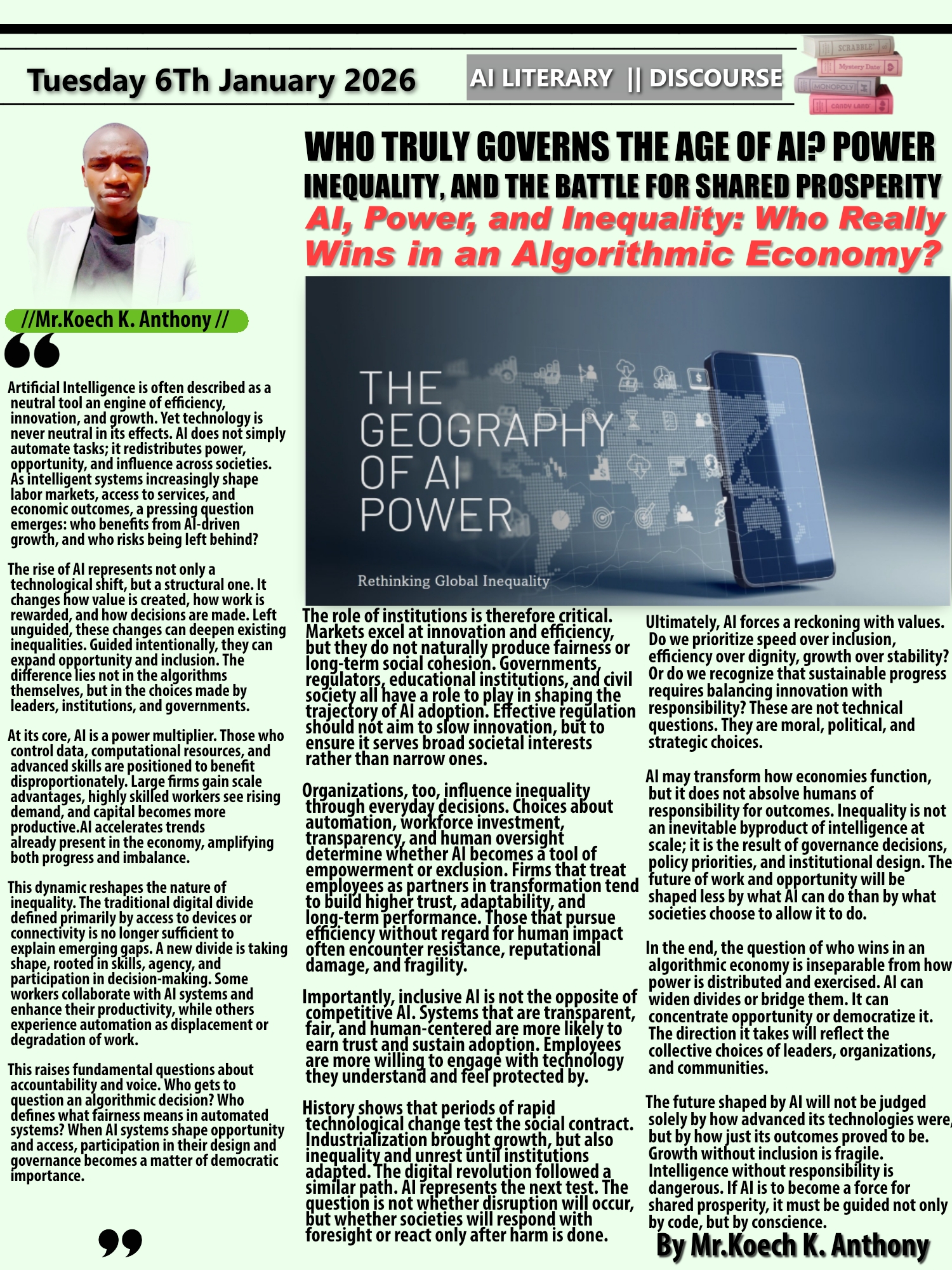
At its core, AI is a power multiplier. Those who
control data, computational resources, and
advanced skills are positioned to benefit
disproportionately. Large firms gain scale
advantages, highly skilled workers see rising
demand, and capital becomes more
productive.AI accelerates trends
already present in the economy, amplifying
both progress and imbalance.
This dynamic reshapes the nature of
inequality. The traditional digital divide
defined primarily by access to devices or
connectivity is no longer sufficient to
explain emerging gaps. A new divide is taking
shape, rooted in skills, agency, and
participation in decision-making. Some
workers collaborate with AI systems and
enhance their productivity, while others
experience automation as displacement or
degradation of work.
This raises fundamental questions about
accountability and voice. Who gets to
question an algorithmic decision? Who
defines what fairness means in automated
systems? When AI systems shape opportunity
and access, participation in their design and
governance becomes a matter of democratic
importance.
The role of institutions is therefore critical.
Markets excel at innovation and efficiency,
but they do not naturally produce fairness or
long-term social cohesion. Governments,
regulators, educational institutions, and civil
society all have a role to play in shaping the
trajectory of AI adoption. Effective regulation
should not aim to slow innovation, but to
ensure it serves broad societal interests
rather than narrow ones.
Organizations, too, influence inequality
through everyday decisions. Choices about
automation, workforce investment,
transparency, and human oversight
determine whether AI becomes a tool of
empowerment or exclusion. Firms that treat
employees as partners in transformation tend
to build higher trust, adaptability, and
long-term performance. Those that pursue
efficiency without regard for human impact
often encounter resistance, reputational
damage, and fragility.
Importantly, inclusive AI is not the opposite of
competitive AI. Systems that are transparent,
fair, and human-centered are more likely to
earn trust and sustain adoption. Employees
are more willing to engage with technology
they understand and feel protected by.
History shows that periods of rapid
technological change test the social contract.
Industrialization brought growth, but also
inequality and unrest until institutions
adapted. The digital revolution followed a
similar path. AI represents the next test. The
question is not whether disruption will occur,
but whether societies will respond with
foresight or react only after harm is done.
Ultimately, AI forces a reckoning with values.
Do we prioritize speed over inclusion,
efficiency over dignity, growth over stability?
Or do we recognize that sustainable progress
requires balancing innovation with
responsibility? These are not technical
questions. They are moral, political, and
strategic choices.
AI may transform how economies function,
but it does not absolve humans of
responsibility for outcomes. Inequality is not
an inevitable byproduct of intelligence at
scale; it is the result of governance decisions,
policy priorities, and institutional design. The
future of work and opportunity will be
shaped less by what AI can do than by what
societies choose to allow it to do.
In the end, the question of who wins in an
algorithmic economy is inseparable from how
power is distributed and exercised. AI can
widen divides or bridge them. It can
concentrate opportunity or democratize it.
The direction it takes will reflect the
collective choices of leaders, organizations,
and communities.
The future shaped by AI will not be judged
solely by how advanced its technologies were,
but by how just its outcomes proved to be.
Growth without inclusion is fragile.
Intelligence without responsibility is
dangerous. If AI is to become a force for
shared prosperity, it must be guided not only
by code, but by conscience.
neutral tool an engine of efficiency,
innovation, and growth. Yet technology is
never neutral in its effects. AI does not simply
automate tasks; it redistributes power,
opportunity, and influence across societies.
As intelligent systems increasingly shape
labor markets, access to services, and
economic outcomes, a pressing question
emerges: who benefits from AI-driven
growth, and who risks being left behind?
The rise of AI represents not only a
technological shift, but a structural one. It
changes how value is created, how work is
rewarded, and how decisions are made. Left
unguided, these changes can deepen existing
inequalities. Guided intentionally, they can
expand opportunity and inclusion. The
difference lies not in the algorithms
themselves, but in the choices made by
leaders, institutions, and governments.
At its core, AI is a power multiplier. Those who
control data, computational resources, and
advanced skills are positioned to benefit
disproportionately. Large firms gain scale
advantages, highly skilled workers see rising
demand, and capital becomes more
productive.AI accelerates trends
already present in the economy, amplifying
both progress and imbalance.
This dynamic reshapes the nature of
inequality. The traditional digital divide
defined primarily by access to devices or
connectivity is no longer sufficient to
explain emerging gaps. A new divide is taking
shape, rooted in skills, agency, and
participation in decision-making. Some
workers collaborate with AI systems and
enhance their productivity, while others
experience automation as displacement or
degradation of work.
This raises fundamental questions about
accountability and voice. Who gets to
question an algorithmic decision? Who
defines what fairness means in automated
systems? When AI systems shape opportunity
and access, participation in their design and
governance becomes a matter of democratic
importance.
The role of institutions is therefore critical.
Markets excel at innovation and efficiency,
but they do not naturally produce fairness or
long-term social cohesion. Governments,
regulators, educational institutions, and civil
society all have a role to play in shaping the
trajectory of AI adoption. Effective regulation
should not aim to slow innovation, but to
ensure it serves broad societal interests
rather than narrow ones.
Organizations, too, influence inequality
through everyday decisions. Choices about
automation, workforce investment,
transparency, and human oversight
determine whether AI becomes a tool of
empowerment or exclusion. Firms that treat
employees as partners in transformation tend
to build higher trust, adaptability, and
long-term performance. Those that pursue
efficiency without regard for human impact
often encounter resistance, reputational
damage, and fragility.
Importantly, inclusive AI is not the opposite of
competitive AI. Systems that are transparent,
fair, and human-centered are more likely to
earn trust and sustain adoption. Employees
are more willing to engage with technology
they understand and feel protected by.
History shows that periods of rapid
technological change test the social contract.
Industrialization brought growth, but also
inequality and unrest until institutions
adapted. The digital revolution followed a
similar path. AI represents the next test. The
question is not whether disruption will occur,
but whether societies will respond with
foresight or react only after harm is done.
Ultimately, AI forces a reckoning with values.
Do we prioritize speed over inclusion,
efficiency over dignity, growth over stability?
Or do we recognize that sustainable progress
requires balancing innovation with
responsibility? These are not technical
questions. They are moral, political, and
strategic choices.
AI may transform how economies function,
but it does not absolve humans of
responsibility for outcomes. Inequality is not
an inevitable byproduct of intelligence at
scale; it is the result of governance decisions,
policy priorities, and institutional design. The
future of work and opportunity will be
shaped less by what AI can do than by what
societies choose to allow it to do.
In the end, the question of who wins in an
algorithmic economy is inseparable from how
power is distributed and exercised. AI can
widen divides or bridge them. It can
concentrate opportunity or democratize it.
The direction it takes will reflect the
collective choices of leaders, organizations,
and communities.
The future shaped by AI will not be judged
solely by how advanced its technologies were,
but by how just its outcomes proved to be.
Growth without inclusion is fragile.
Intelligence without responsibility is
dangerous. If AI is to become a force for
shared prosperity, it must be guided not only
by code, but by conscience.