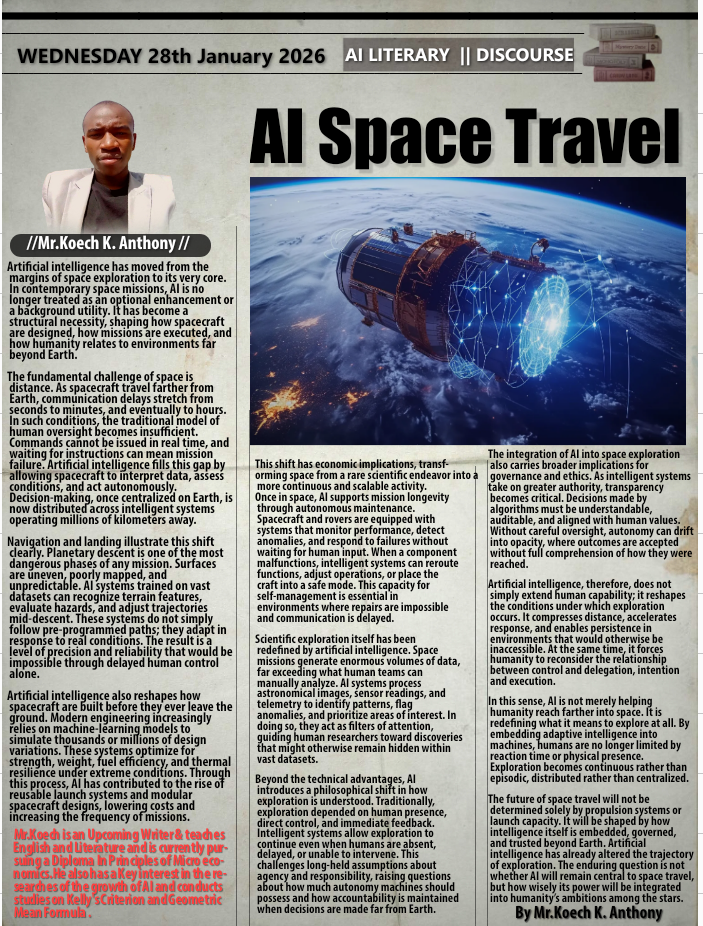
Artificial intelligence has moved from the margins of space exploration to its very core. In contemporary space missions, AI is no longer treated as an optional enhancement or a background utility. It has become a structural necessity, shaping how spacecraft are designed, how missions are executed, and how humanity relates to environments far beyond Earth.
The fundamental challenge of space is distance. As spacecraft travel farther from Earth, communication delays stretch from seconds to minutes, and eventually to hours. In such conditions, the traditional model of human oversight becomes insufficient. Commands cannot be issued in real time, and waiting for instructions can mean mission failure. Artificial intelligence fills this gap by allowing spacecraft to interpret data, assess conditions, and act autonomously. Decision-making, once centralized on Earth, is now distributed across intelligent systems operating millions of kilometers away.
Navigation and landing illustrate this shift clearly. Planetary descent is one of the most dangerous phases of any mission. Surfaces are uneven, poorly mapped, and unpredictable. AI systems trained on vast datasets can recognize terrain features, evaluate hazards, and adjust trajectories mid-descent. These systems do not simply follow pre-programmed paths; they adapt in response to real conditions. The result is a level of precision and reliability that would be impossible through delayed human control alone.
Artificial intelligence also reshapes how spacecraft are built before they ever leave the ground. Modern engineering increasingly relies on machine-learning models to simulate thousands or millions of design variations. These systems optimize for strength, weight, fuel efficiency, and thermal resilience under extreme conditions. Through this process, AI has contributed to the rise of reusable launch systems and modular spacecraft designs, lowering costs and increasing the frequency of missions. This shift has economic implications, transforming space from a rare scientific endeavor into a more continuous and scalable activity.
Once in space, AI supports mission longevity through autonomous maintenance. Spacecraft and rovers are equipped with systems that monitor performance, detect anomalies, and respond to failures without waiting for human input. When a component malfunctions, intelligent systems can reroute functions, adjust operations, or place the craft into a safe mode. This capacity for self-management is essential in environments where repairs are impossible and communication is delayed.
Scientific exploration itself has been redefined by artificial intelligence. Space missions generate enormous volumes of data, far exceeding what human teams can manually analyze. AI systems process astronomical images, sensor readings, and telemetry to identify patterns, flag anomalies, and prioritize areas of interest. In doing so, they act as filters of attention, guiding human researchers toward discoveries that might otherwise remain hidden within vast datasets.
Beyond the technical advantages, AI introduces a philosophical shift in how exploration is understood. Traditionally, exploration depended on human presence, direct control, and immediate feedback. Intelligent systems allow exploration to continue even when humans are absent, delayed, or unable to intervene. This challenges long-held assumptions about agency and responsibility, raising questions about how much autonomy machines should possess and how accountability is maintained when decisions are made far from Earth.
The integration of AI into space exploration also carries broader implications for governance and ethics. As intelligent systems take on greater authority, transparency becomes critical. Decisions made by algorithms must be understandable, auditable, and aligned with human values. Without careful oversight, autonomy can drift into opacity, where outcomes are accepted without full comprehension of how they were reached.
Artificial intelligence, therefore, does not simply extend human capability; it reshapes the conditions under which exploration occurs. It compresses distance, accelerates response, and enables persistence in environments that would otherwise be inaccessible. At the same time, it forces humanity to reconsider the relationship between control and delegation, intention and execution.
In this sense, AI is not merely helping humanity reach farther into space. It is redefining what it means to explore at all. By embedding adaptive intelligence into machines, humans are no longer limited by reaction time or physical presence. Exploration becomes continuous rather than episodic, distributed rather than centralized.
The future of space travel will not be determined solely by propulsion systems or launch capacity. It will be shaped by how intelligence itself is embedded, governed, and trusted beyond Earth. Artificial intelligence has already altered the trajectory of exploration. The enduring question is not whether AI will remain central to space travel, but how wisely its power will be integrated into humanity’s ambitions among the stars.
The fundamental challenge of space is distance. As spacecraft travel farther from Earth, communication delays stretch from seconds to minutes, and eventually to hours. In such conditions, the traditional model of human oversight becomes insufficient. Commands cannot be issued in real time, and waiting for instructions can mean mission failure. Artificial intelligence fills this gap by allowing spacecraft to interpret data, assess conditions, and act autonomously. Decision-making, once centralized on Earth, is now distributed across intelligent systems operating millions of kilometers away.
Navigation and landing illustrate this shift clearly. Planetary descent is one of the most dangerous phases of any mission. Surfaces are uneven, poorly mapped, and unpredictable. AI systems trained on vast datasets can recognize terrain features, evaluate hazards, and adjust trajectories mid-descent. These systems do not simply follow pre-programmed paths; they adapt in response to real conditions. The result is a level of precision and reliability that would be impossible through delayed human control alone.
Artificial intelligence also reshapes how spacecraft are built before they ever leave the ground. Modern engineering increasingly relies on machine-learning models to simulate thousands or millions of design variations. These systems optimize for strength, weight, fuel efficiency, and thermal resilience under extreme conditions. Through this process, AI has contributed to the rise of reusable launch systems and modular spacecraft designs, lowering costs and increasing the frequency of missions. This shift has economic implications, transforming space from a rare scientific endeavor into a more continuous and scalable activity.
Once in space, AI supports mission longevity through autonomous maintenance. Spacecraft and rovers are equipped with systems that monitor performance, detect anomalies, and respond to failures without waiting for human input. When a component malfunctions, intelligent systems can reroute functions, adjust operations, or place the craft into a safe mode. This capacity for self-management is essential in environments where repairs are impossible and communication is delayed.
Scientific exploration itself has been redefined by artificial intelligence. Space missions generate enormous volumes of data, far exceeding what human teams can manually analyze. AI systems process astronomical images, sensor readings, and telemetry to identify patterns, flag anomalies, and prioritize areas of interest. In doing so, they act as filters of attention, guiding human researchers toward discoveries that might otherwise remain hidden within vast datasets.
Beyond the technical advantages, AI introduces a philosophical shift in how exploration is understood. Traditionally, exploration depended on human presence, direct control, and immediate feedback. Intelligent systems allow exploration to continue even when humans are absent, delayed, or unable to intervene. This challenges long-held assumptions about agency and responsibility, raising questions about how much autonomy machines should possess and how accountability is maintained when decisions are made far from Earth.
The integration of AI into space exploration also carries broader implications for governance and ethics. As intelligent systems take on greater authority, transparency becomes critical. Decisions made by algorithms must be understandable, auditable, and aligned with human values. Without careful oversight, autonomy can drift into opacity, where outcomes are accepted without full comprehension of how they were reached.
Artificial intelligence, therefore, does not simply extend human capability; it reshapes the conditions under which exploration occurs. It compresses distance, accelerates response, and enables persistence in environments that would otherwise be inaccessible. At the same time, it forces humanity to reconsider the relationship between control and delegation, intention and execution.
In this sense, AI is not merely helping humanity reach farther into space. It is redefining what it means to explore at all. By embedding adaptive intelligence into machines, humans are no longer limited by reaction time or physical presence. Exploration becomes continuous rather than episodic, distributed rather than centralized.
The future of space travel will not be determined solely by propulsion systems or launch capacity. It will be shaped by how intelligence itself is embedded, governed, and trusted beyond Earth. Artificial intelligence has already altered the trajectory of exploration. The enduring question is not whether AI will remain central to space travel, but how wisely its power will be integrated into humanity’s ambitions among the stars.