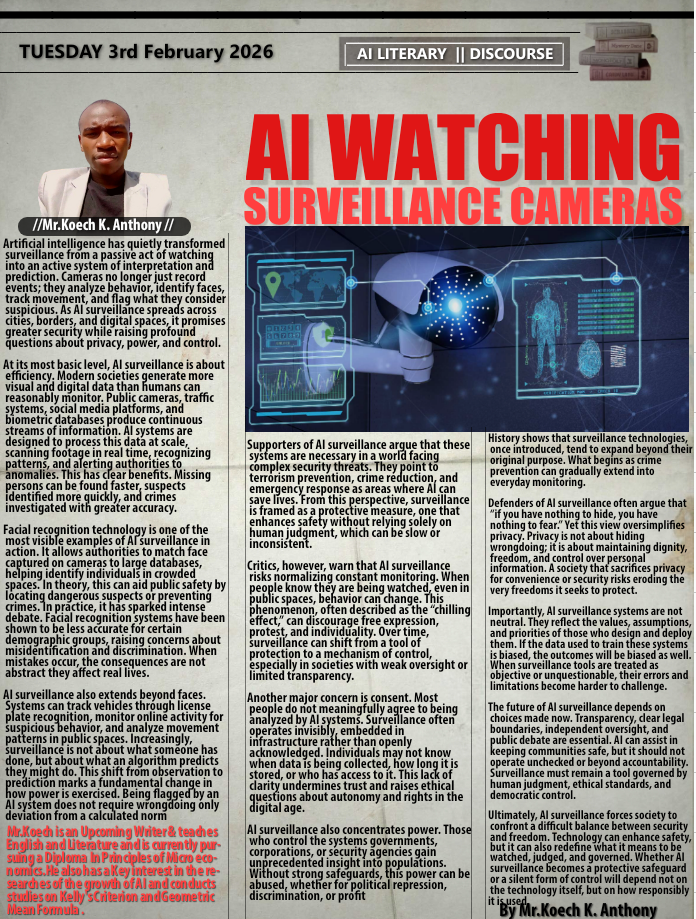
Artificial intelligence has quietly transformed surveillance from a passive act of watching into an active system of interpretation and prediction. Cameras no longer just record events; they analyze behavior, identify faces, track movement, and flag what they consider suspicious. As AI surveillance spreads across cities, borders, and digital spaces, it promises greater security while raising profound questions about privacy, power, and control.
At its most basic level, AI surveillance is about efficiency. Modern societies generate more visual and digital data than humans can reasonably monitor. Public cameras, traffic systems, social media platforms, and biometric databases produce continuous streams of information. AI systems are designed to process this data at scale, scanning footage in real time, recognizing patterns, and alerting authorities to anomalies. This has clear benefits. Missing persons can be found faster, suspects identified more quickly, and crimes investigated with greater accuracy.
Facial recognition technology is one of the most visible examples of AI surveillance in action. It allows authorities to match faces captured on cameras to large databases, helping identify individuals in crowded spaces. In theory, this can aid public safety by locating dangerous suspects or preventing crimes. In practice, it has sparked intense debate. Facial recognition systems have been shown to be less accurate for certain demographic groups, raising concerns about misidentification and discrimination. When mistakes occur, the consequences are not abstract they affect real lives.
AI surveillance also extends beyond faces. Systems can track vehicles through license plate recognition, monitor online activity for suspicious behavior, and analyze movement patterns in public spaces. Increasingly, surveillance is not about what someone has done, but about what an algorithm predicts they might do. This shift from observation to prediction marks a fundamental change in how power is exercised. Being flagged by an AI system does not require wrongdoing only deviation from a calculated norm.
Supporters of AI surveillance argue that these systems are necessary in a world facing complex security threats. They point to terrorism prevention, crime reduction, and emergency response as areas where AI can save lives. From this perspective, surveillance is framed as a protective measure, one that enhances safety without relying solely on human judgment, which can be slow or inconsistent.
Critics, however, warn that AI surveillance risks normalizing constant monitoring. When people know they are being watched, even in public spaces, behavior can change. This phenomenon, often described as the “chilling effect,” can discourage free expression, protest, and individuality. Over time, surveillance can shift from a tool of protection to a mechanism of control, especially in societies with weak oversight or limited transparency.
Another major concern is consent. Most people do not meaningfully agree to being analyzed by AI systems. Surveillance often operates invisibly, embedded in infrastructure rather than openly acknowledged. Individuals may not know when data is being collected, how long it is stored, or who has access to it. This lack of clarity undermines trust and raises ethical questions about autonomy and rights in the digital age.
AI surveillance also concentrates power. Those who control the systems governments, corporations, or security agencies gain unprecedented insight into populations. Without strong safeguards, this power can be abused, whether for political repression, discrimination, or profit. History shows that surveillance technologies, once introduced, tend to expand beyond their original purpose. What begins as crime prevention can gradually extend into everyday monitoring.
Defenders of AI surveillance often argue that “if you have nothing to hide, you have nothing to fear.” Yet this view oversimplifies privacy. Privacy is not about hiding wrongdoing; it is about maintaining dignity, freedom, and control over personal information. A society that sacrifices privacy for convenience or security risks eroding the very freedoms it seeks to protect.
Importantly, AI surveillance systems are not neutral. They reflect the values, assumptions, and priorities of those who design and deploy them. If the data used to train these systems is biased, the outcomes will be biased as well. When surveillance tools are treated as objective or unquestionable, their errors and limitations become harder to challenge.
The future of AI surveillance depends on choices made now. Transparency, clear legal boundaries, independent oversight, and public debate are essential. AI can assist in keeping communities safe, but it should not operate unchecked or beyond accountability. Surveillance must remain a tool governed by human judgment, ethical standards, and democratic control.
Ultimately, AI surveillance forces society to confront a difficult balance between security and freedom. Technology can enhance safety, but it can also redefine what it means to be watched, judged, and governed. Whether AI surveillance becomes a protective safeguard or a silent form of control will depend not on the technology itself, but on how responsibly it is used.
At its most basic level, AI surveillance is about efficiency. Modern societies generate more visual and digital data than humans can reasonably monitor. Public cameras, traffic systems, social media platforms, and biometric databases produce continuous streams of information. AI systems are designed to process this data at scale, scanning footage in real time, recognizing patterns, and alerting authorities to anomalies. This has clear benefits. Missing persons can be found faster, suspects identified more quickly, and crimes investigated with greater accuracy.
Facial recognition technology is one of the most visible examples of AI surveillance in action. It allows authorities to match faces captured on cameras to large databases, helping identify individuals in crowded spaces. In theory, this can aid public safety by locating dangerous suspects or preventing crimes. In practice, it has sparked intense debate. Facial recognition systems have been shown to be less accurate for certain demographic groups, raising concerns about misidentification and discrimination. When mistakes occur, the consequences are not abstract they affect real lives.
AI surveillance also extends beyond faces. Systems can track vehicles through license plate recognition, monitor online activity for suspicious behavior, and analyze movement patterns in public spaces. Increasingly, surveillance is not about what someone has done, but about what an algorithm predicts they might do. This shift from observation to prediction marks a fundamental change in how power is exercised. Being flagged by an AI system does not require wrongdoing only deviation from a calculated norm.
Supporters of AI surveillance argue that these systems are necessary in a world facing complex security threats. They point to terrorism prevention, crime reduction, and emergency response as areas where AI can save lives. From this perspective, surveillance is framed as a protective measure, one that enhances safety without relying solely on human judgment, which can be slow or inconsistent.
Critics, however, warn that AI surveillance risks normalizing constant monitoring. When people know they are being watched, even in public spaces, behavior can change. This phenomenon, often described as the “chilling effect,” can discourage free expression, protest, and individuality. Over time, surveillance can shift from a tool of protection to a mechanism of control, especially in societies with weak oversight or limited transparency.
Another major concern is consent. Most people do not meaningfully agree to being analyzed by AI systems. Surveillance often operates invisibly, embedded in infrastructure rather than openly acknowledged. Individuals may not know when data is being collected, how long it is stored, or who has access to it. This lack of clarity undermines trust and raises ethical questions about autonomy and rights in the digital age.
AI surveillance also concentrates power. Those who control the systems governments, corporations, or security agencies gain unprecedented insight into populations. Without strong safeguards, this power can be abused, whether for political repression, discrimination, or profit. History shows that surveillance technologies, once introduced, tend to expand beyond their original purpose. What begins as crime prevention can gradually extend into everyday monitoring.
Defenders of AI surveillance often argue that “if you have nothing to hide, you have nothing to fear.” Yet this view oversimplifies privacy. Privacy is not about hiding wrongdoing; it is about maintaining dignity, freedom, and control over personal information. A society that sacrifices privacy for convenience or security risks eroding the very freedoms it seeks to protect.
Importantly, AI surveillance systems are not neutral. They reflect the values, assumptions, and priorities of those who design and deploy them. If the data used to train these systems is biased, the outcomes will be biased as well. When surveillance tools are treated as objective or unquestionable, their errors and limitations become harder to challenge.
The future of AI surveillance depends on choices made now. Transparency, clear legal boundaries, independent oversight, and public debate are essential. AI can assist in keeping communities safe, but it should not operate unchecked or beyond accountability. Surveillance must remain a tool governed by human judgment, ethical standards, and democratic control.
Ultimately, AI surveillance forces society to confront a difficult balance between security and freedom. Technology can enhance safety, but it can also redefine what it means to be watched, judged, and governed. Whether AI surveillance becomes a protective safeguard or a silent form of control will depend not on the technology itself, but on how responsibly it is used.