Education at a Crossroads
Is Kenya Ready for the New Curriculum??
Education remains the backbone of every society, shaping not only individual lives but also determining the stability and growth of a nation’s economy. In Kenya, education has long been viewed as the engine of development. However, recent changes in the education system have sparked national debate, uncertainty, and concern among educators, parents, and learners alike.
Over the past few years, Kenya’s education system has undergone significant transformation, transitioning from the long-established 8-4-4 system to the new 2-6-3-3-3 Competency-Based Education (CBE) system. While the shift was intended to modernize learning and align education with real-life skills, the implementation has raised serious questions. Many schools under the new system appear overwhelmed, lacking adequate resources, while others remain confused about which direction to take. For some institutions, the transition has been more frustrating than progressive.
Concerns were further highlighted yesterday during a parliamentary committee meeting where lawmakers engaged in heated discussions over the funding of the new education model. Members questioned whether sufficient financial planning had been put in place to support the curriculum. At the same time, heads of institutions across the country are facing immense pressure following remarks from the Ministry of Education. During a tour in Kisii County, Cabinet Secretary Ogamba stated that “every student should be in school with or without uniform and school fees.” He warned that school heads who fail to comply with this directive risk losing their jobs, a statement that has left many administrators anxious and uncertain about enforcement and sustainability
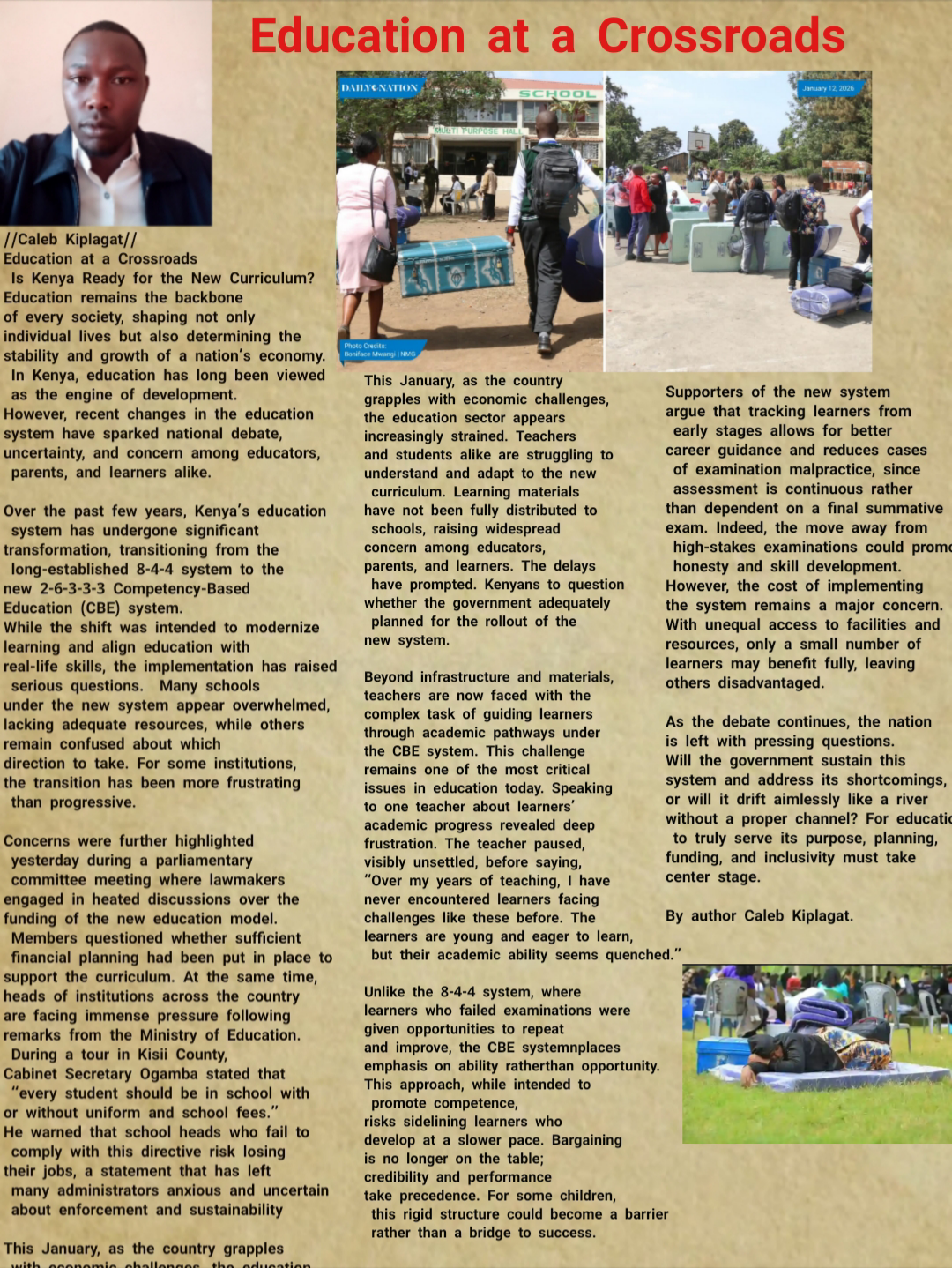
This January, as the country grapples with economic challenges, the education sector appears increasingly strained. Teachers and students alike are struggling to understand and adapt to the new curriculum. Learning materials have not been fully distributed to schools, raising widespread concern among educators, parents, and learners. The delays have prompted Kenyans to question whether the government adequately planned for the rollout of the new system.
Beyond infrastructure and materials, teachers are now faced with the complex task of guiding learners through academic pathways under the CBE system. This challenge remains one of the most critical issues in education today. Speaking to one teacher about learners’ academic progress revealed deep frustration. The teacher paused, visibly unsettled, before saying, “Over my years of teaching, I have never encountered learners facing challenges like these before. The learners are young and eager to learn, but their academic ability seems quenched.”
Unlike the 8-4-4 system, where learners who failed examinations were given opportunities to repeat and improve, the CBE system places emphasis on ability rather than opportunity. This approach, while intended to promote competence, risks sidelining learners who develop at a slower pace. Bargaining is no longer on the table; credibility and performance take precedence. For some children, this rigid structure could become a barrier rather than a bridge to success.
Supporters of the new system argue that tracking learners from early stages allows for better career guidance and reduces cases of examination malpractice, since assessment is continuous rather than dependent on a final summative exam. Indeed, the move away from high-stakes examinations could promote honesty and skill development. However, the cost of implementing the system remains a major concern. With unequal access to facilities and resources, only a small number of learners may benefit fully, leaving others disadvantaged.
As the debate continues, the nation is left with pressing questions. Will the government sustain this system and address its shortcomings, or will it drift aimlessly like a river without a proper channel? For education to truly serve its purpose, planning, funding, and inclusivity must take center stage.
By author Caleb Kiplagat.
Is Kenya Ready for the New Curriculum??
Education remains the backbone of every society, shaping not only individual lives but also determining the stability and growth of a nation’s economy. In Kenya, education has long been viewed as the engine of development. However, recent changes in the education system have sparked national debate, uncertainty, and concern among educators, parents, and learners alike.
Over the past few years, Kenya’s education system has undergone significant transformation, transitioning from the long-established 8-4-4 system to the new 2-6-3-3-3 Competency-Based Education (CBE) system. While the shift was intended to modernize learning and align education with real-life skills, the implementation has raised serious questions. Many schools under the new system appear overwhelmed, lacking adequate resources, while others remain confused about which direction to take. For some institutions, the transition has been more frustrating than progressive.
Concerns were further highlighted yesterday during a parliamentary committee meeting where lawmakers engaged in heated discussions over the funding of the new education model. Members questioned whether sufficient financial planning had been put in place to support the curriculum. At the same time, heads of institutions across the country are facing immense pressure following remarks from the Ministry of Education. During a tour in Kisii County, Cabinet Secretary Ogamba stated that “every student should be in school with or without uniform and school fees.” He warned that school heads who fail to comply with this directive risk losing their jobs, a statement that has left many administrators anxious and uncertain about enforcement and sustainability
This January, as the country grapples with economic challenges, the education sector appears increasingly strained. Teachers and students alike are struggling to understand and adapt to the new curriculum. Learning materials have not been fully distributed to schools, raising widespread concern among educators, parents, and learners. The delays have prompted Kenyans to question whether the government adequately planned for the rollout of the new system.
Beyond infrastructure and materials, teachers are now faced with the complex task of guiding learners through academic pathways under the CBE system. This challenge remains one of the most critical issues in education today. Speaking to one teacher about learners’ academic progress revealed deep frustration. The teacher paused, visibly unsettled, before saying, “Over my years of teaching, I have never encountered learners facing challenges like these before. The learners are young and eager to learn, but their academic ability seems quenched.”
Unlike the 8-4-4 system, where learners who failed examinations were given opportunities to repeat and improve, the CBE system places emphasis on ability rather than opportunity. This approach, while intended to promote competence, risks sidelining learners who develop at a slower pace. Bargaining is no longer on the table; credibility and performance take precedence. For some children, this rigid structure could become a barrier rather than a bridge to success.
Supporters of the new system argue that tracking learners from early stages allows for better career guidance and reduces cases of examination malpractice, since assessment is continuous rather than dependent on a final summative exam. Indeed, the move away from high-stakes examinations could promote honesty and skill development. However, the cost of implementing the system remains a major concern. With unequal access to facilities and resources, only a small number of learners may benefit fully, leaving others disadvantaged.
As the debate continues, the nation is left with pressing questions. Will the government sustain this system and address its shortcomings, or will it drift aimlessly like a river without a proper channel? For education to truly serve its purpose, planning, funding, and inclusivity must take center stage.
By author Caleb Kiplagat.