Are We Becoming Lazy Thinkers Because of AI?
There is a quiet shift happening in how we think.
Not long ago, solving a problem required effort. You had to search, compare, reflect, and sometimes struggle before arriving at an answer. That process was not always efficient, but it shaped something deeper than knowledge. It built thinking. Today, that process is changing. With artificial intelligence, answers arrive almost instantly. Explanations are generated in seconds. Ideas are structured before you fully form them yourself.
This raises an uncomfortable question. Are we becoming lazy thinkers because of AI?
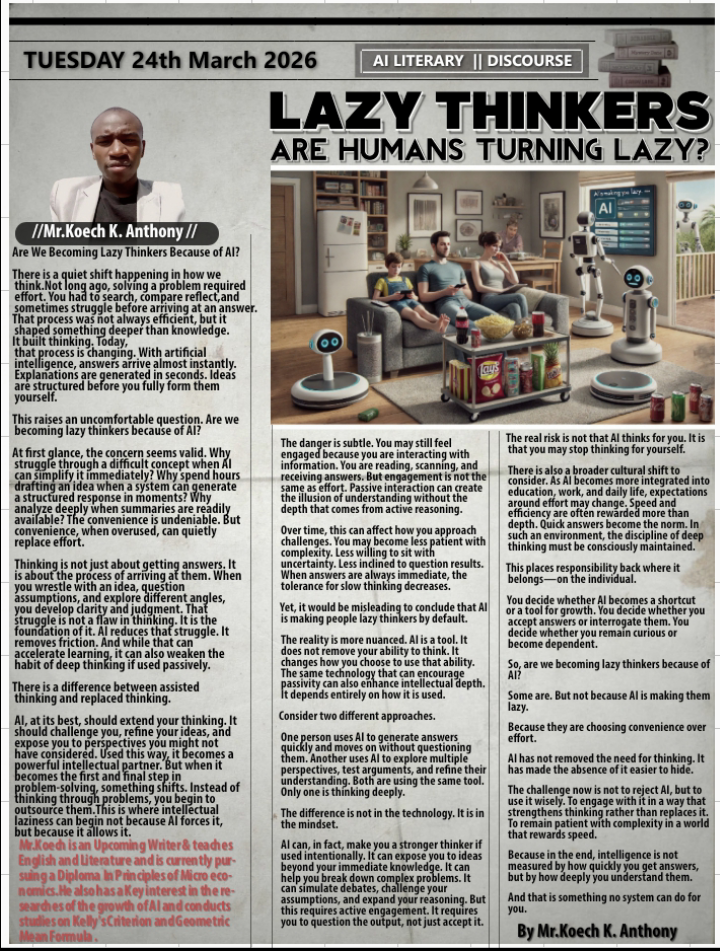
At first glance, the concern seems valid. Why struggle through a difficult concept when AI can simplify it immediately? Why spend hours drafting an idea when a system can generate a structured response in moments? Why analyze deeply when summaries are readily available? The convenience is undeniable. But convenience, when overused, can quietly replace effort.
Thinking is not just about getting answers. It is about the process of arriving at them. When you wrestle with an idea, question assumptions, and explore different angles, you develop clarity and judgment. That struggle is not a flaw in thinking. It is the foundation of it. AI reduces that struggle. It removes friction. And while that can accelerate learning, it can also weaken the habit of deep thinking if used passively.
There is a difference between assisted thinking and replaced thinking.
AI, at its best, should extend your thinking. It should challenge you, refine your ideas, and expose you to perspectives you might not have considered. Used this way, it becomes a powerful intellectual partner. But when it becomes the first and final step in problem-solving, something shifts. Instead of thinking through problems, you begin to outsource them.
This is where intellectual laziness can begin—not because AI forces it, but because it allows it.
The danger is subtle. You may still feel engaged because you are interacting with information. You are reading, scanning, and receiving answers. But engagement is not the same as effort. Passive interaction can create the illusion of understanding without the depth that comes from active reasoning.
Over time, this can affect how you approach challenges. You may become less patient with complexity. Less willing to sit with uncertainty. Less inclined to question results. When answers are always immediate, the tolerance for slow thinking decreases.
Yet, it would be misleading to conclude that AI is making people lazy thinkers by default.
The reality is more nuanced. AI is a tool. It does not remove your ability to think. It changes how you choose to use that ability. The same technology that can encourage passivity can also enhance intellectual depth. It depends entirely on how it is used.
Consider two different approaches.
One person uses AI to generate answers quickly and moves on without questioning them. Another uses AI to explore multiple perspectives, test arguments, and refine their understanding. Both are using the same tool. Only one is thinking deeply.
The difference is not in the technology. It is in the mindset.
AI can, in fact, make you a stronger thinker if used intentionally. It can expose you to ideas beyond your immediate knowledge. It can help you break down complex problems. It can simulate debates, challenge your assumptions, and expand your reasoning. But this requires active engagement. It requires you to question the output, not just accept it.
The real risk is not that AI thinks for you. It is that you may stop thinking for yourself.
There is also a broader cultural shift to consider. As AI becomes more integrated into education, work, and daily life, expectations around effort may change. Speed and efficiency are often rewarded more than depth. Quick answers become the norm. In such an environment, the discipline of deep thinking must be consciously maintained.
This places responsibility back where it belongs—on the individual.
You decide whether AI becomes a shortcut or a tool for growth. You decide whether you accept answers or interrogate them. You decide whether you remain curious or become dependent.
So, are we becoming lazy thinkers because of AI?
Some are. But not because AI is making them lazy.
Because they are choosing convenience over effort.
AI has not removed the need for thinking. It has made the absence of it easier to hide.
The challenge now is not to reject AI, but to use it wisely. To engage with it in a way that strengthens thinking rather than replaces it. To remain patient with complexity in a world that rewards speed.
Because in the end, intelligence is not measured by how quickly you get answers, but by how deeply you understand them.
And that is something no system can do for you.
There is a quiet shift happening in how we think.
Not long ago, solving a problem required effort. You had to search, compare, reflect, and sometimes struggle before arriving at an answer. That process was not always efficient, but it shaped something deeper than knowledge. It built thinking. Today, that process is changing. With artificial intelligence, answers arrive almost instantly. Explanations are generated in seconds. Ideas are structured before you fully form them yourself.
This raises an uncomfortable question. Are we becoming lazy thinkers because of AI?
At first glance, the concern seems valid. Why struggle through a difficult concept when AI can simplify it immediately? Why spend hours drafting an idea when a system can generate a structured response in moments? Why analyze deeply when summaries are readily available? The convenience is undeniable. But convenience, when overused, can quietly replace effort.
Thinking is not just about getting answers. It is about the process of arriving at them. When you wrestle with an idea, question assumptions, and explore different angles, you develop clarity and judgment. That struggle is not a flaw in thinking. It is the foundation of it. AI reduces that struggle. It removes friction. And while that can accelerate learning, it can also weaken the habit of deep thinking if used passively.
There is a difference between assisted thinking and replaced thinking.
AI, at its best, should extend your thinking. It should challenge you, refine your ideas, and expose you to perspectives you might not have considered. Used this way, it becomes a powerful intellectual partner. But when it becomes the first and final step in problem-solving, something shifts. Instead of thinking through problems, you begin to outsource them.
This is where intellectual laziness can begin—not because AI forces it, but because it allows it.
The danger is subtle. You may still feel engaged because you are interacting with information. You are reading, scanning, and receiving answers. But engagement is not the same as effort. Passive interaction can create the illusion of understanding without the depth that comes from active reasoning.
Over time, this can affect how you approach challenges. You may become less patient with complexity. Less willing to sit with uncertainty. Less inclined to question results. When answers are always immediate, the tolerance for slow thinking decreases.
Yet, it would be misleading to conclude that AI is making people lazy thinkers by default.
The reality is more nuanced. AI is a tool. It does not remove your ability to think. It changes how you choose to use that ability. The same technology that can encourage passivity can also enhance intellectual depth. It depends entirely on how it is used.
Consider two different approaches.
One person uses AI to generate answers quickly and moves on without questioning them. Another uses AI to explore multiple perspectives, test arguments, and refine their understanding. Both are using the same tool. Only one is thinking deeply.
The difference is not in the technology. It is in the mindset.
AI can, in fact, make you a stronger thinker if used intentionally. It can expose you to ideas beyond your immediate knowledge. It can help you break down complex problems. It can simulate debates, challenge your assumptions, and expand your reasoning. But this requires active engagement. It requires you to question the output, not just accept it.
The real risk is not that AI thinks for you. It is that you may stop thinking for yourself.
There is also a broader cultural shift to consider. As AI becomes more integrated into education, work, and daily life, expectations around effort may change. Speed and efficiency are often rewarded more than depth. Quick answers become the norm. In such an environment, the discipline of deep thinking must be consciously maintained.
This places responsibility back where it belongs—on the individual.
You decide whether AI becomes a shortcut or a tool for growth. You decide whether you accept answers or interrogate them. You decide whether you remain curious or become dependent.
So, are we becoming lazy thinkers because of AI?
Some are. But not because AI is making them lazy.
Because they are choosing convenience over effort.
AI has not removed the need for thinking. It has made the absence of it easier to hide.
The challenge now is not to reject AI, but to use it wisely. To engage with it in a way that strengthens thinking rather than replaces it. To remain patient with complexity in a world that rewards speed.
Because in the end, intelligence is not measured by how quickly you get answers, but by how deeply you understand them.
And that is something no system can do for you.