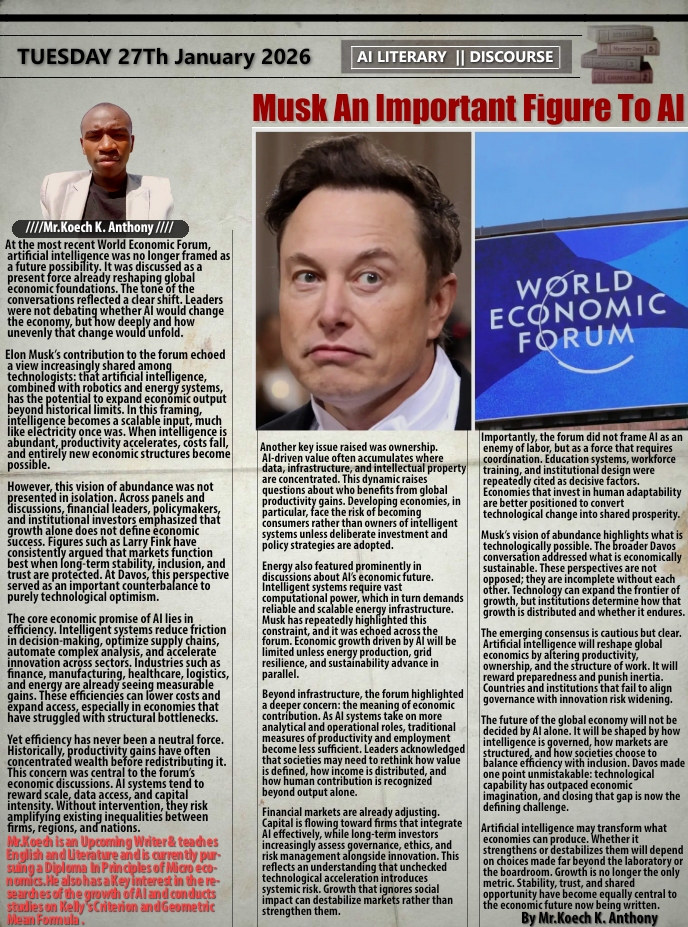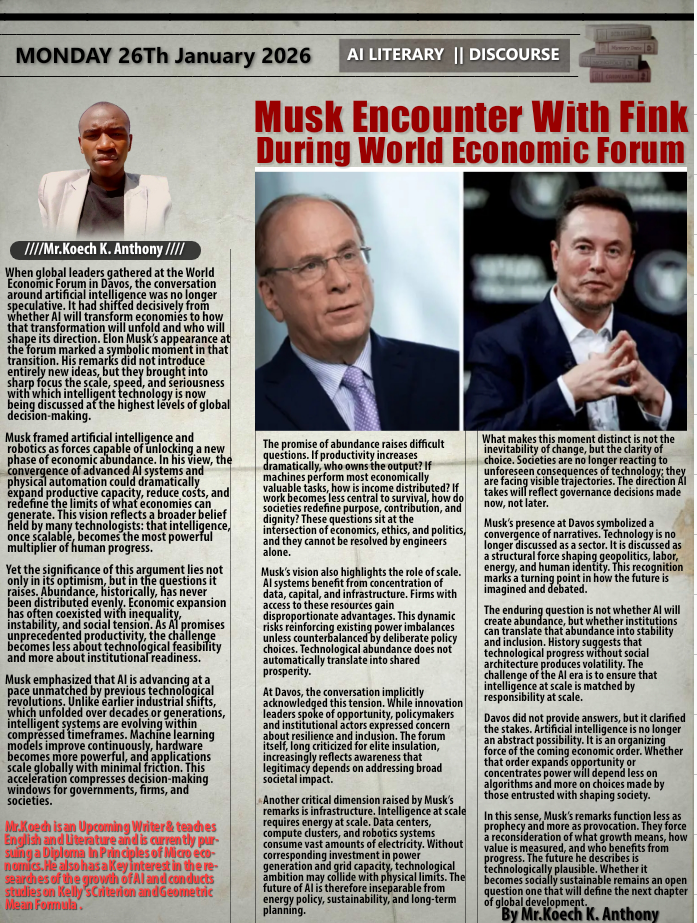
When global leaders gathered at the World Economic Forum in Davos, the conversation around artificial intelligence was no longer speculative. It had shifted decisively from whether AI will transform economies to how that transformation will unfold and who will shape its direction. Elon Musk’s appearance at the forum marked a symbolic moment in that transition. His remarks did not introduce entirely new ideas, but they brought into sharp focus the scale, speed, and seriousness with which intelligent technology is now being discussed at the highest levels of global decision-making.
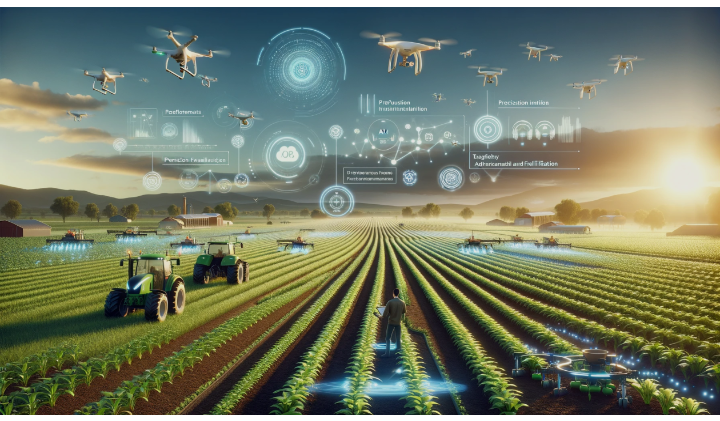
Musk framed artificial intelligence and robotics as forces capable of unlocking a new phase of economic abundance. In his view, the convergence of advanced AI systems and physical automation could dramatically expand productive capacity, reduce costs, and redefine the limits of what economies can generate. This vision reflects a broader belief held by many technologists: that intelligence, once scalable, becomes the most powerful multiplier of human progress.
Yet the significance of this argument lies not only in its optimism, but in the questions it raises. Abundance, historically, has never been distributed evenly. Economic expansion has often coexisted with inequality, instability, and social tension. As AI promises unprecedented productivity, the challenge becomes less about technological feasibility and more about institutional readiness.
Musk emphasized that AI is advancing at a pace unmatched by previous technological revolutions. Unlike earlier industrial shifts, which unfolded over decades or generations, intelligent systems are evolving within compressed timeframes. Machine learning models improve continuously, hardware becomes more powerful, and applications scale globally with minimal friction. This acceleration compresses decision-making windows for governments, firms, and societies.
Such speed alters the nature of leadership itself. Policymakers are forced to regulate technologies they do not fully understand. Businesses adopt systems that outpace existing governance frameworks. Workers encounter change faster than training structures can respond. The result is a widening gap between technological capability and social adaptation.
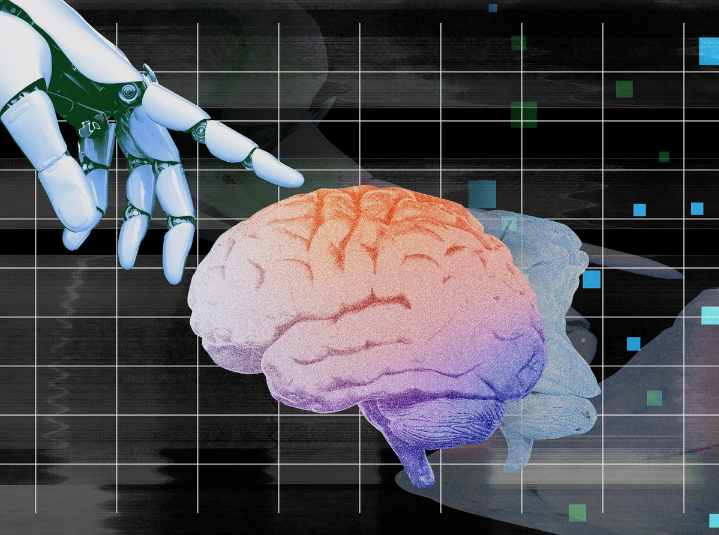
Central to Musk’s Davos message was the idea that AI is not simply a tool for automation, but a system that increasingly performs cognitive functions once reserved for humans. Earlier industrial machines amplified muscle and motion. AI amplifies reasoning, prediction, and decision-making. This distinction matters because it shifts disruption from the margins of the labor market to its core.
Professions once considered insulated from automation now face pressure. Analytical roles, administrative tasks, and even creative processes are being augmented or partially replaced by intelligent systems. The implications extend beyond employment statistics. They challenge assumptions about skill, value, and relevance in a machine-accelerated economy.
In presenting this future, Musk did not dwell on social policy solutions. His contribution was primarily diagnostic rather than prescriptive. He described what technology could enable, not how societies should respond. This absence is instructive. It reflects a broader pattern in technological discourse, where innovation races ahead while governance lags behind.
The promise of abundance raises difficult questions. If productivity increases dramatically, who owns the output? If machines perform most economically valuable tasks, how is income distributed? If work becomes less central to survival, how do societies redefine purpose, contribution, and dignity? These questions sit at the intersection of economics, ethics, and politics, and they cannot be resolved by engineers alone.
Musk’s vision also highlights the role of scale. AI systems benefit from concentration of data, capital, and infrastructure. Firms with access to these resources gain disproportionate advantages. This dynamic risks reinforcing existing power imbalances unless counterbalanced by deliberate policy choices. Technological abundance does not automatically translate into shared prosperity.
At Davos, the conversation implicitly acknowledged this tension. While innovation leaders spoke of opportunity, policymakers and institutional actors expressed concern about resilience and inclusion. The forum itself, long criticized for elite insulation, increasingly reflects awareness that legitimacy depends on addressing broad societal impact.
Another critical dimension raised by Musk’s remarks is infrastructure. Intelligence at scale requires energy at scale. Data centers, compute clusters, and robotics systems consume vast amounts of electricity. Without corresponding investment in power generation and grid capacity, technological ambition may collide with physical limits. The future of AI is therefore inseparable from energy policy, sustainability, and long-term planning.
What makes this moment distinct is not the inevitability of change, but the clarity of choice. Societies are no longer reacting to unforeseen consequences of technology; they are facing visible trajectories. The direction AI takes will reflect governance decisions made now, not later.
Musk’s presence at Davos symbolized a convergence of narratives. Technology is no longer discussed as a sector. It is discussed as a structural force shaping geopolitics, labor, energy, and human identity. This recognition marks a turning point in how the future is imagined and debated.
The enduring question is not whether AI will create abundance, but whether institutions can translate that abundance into stability and inclusion. History suggests that technological progress without social architecture produces volatility. The challenge of the AI era is to ensure that intelligence at scale is matched by responsibility at scale.
Davos did not provide answers, but it clarified the stakes. Artificial intelligence is no longer an abstract possibility. It is an organizing force of the coming economic order. Whether that order expands opportunity or concentrates power will depend less on algorithms and more on choices made by those entrusted with shaping society.
In this sense, Musk’s remarks function less as prophecy and more as provocation. They force a reconsideration of what growth means, how value is measured, and who benefits from progress. The future he describes is technologically plausible. Whether it becomes socially sustainable remains an open question one that will define the next chapter of global development.
Musk framed artificial intelligence and robotics as forces capable of unlocking a new phase of economic abundance. In his view, the convergence of advanced AI systems and physical automation could dramatically expand productive capacity, reduce costs, and redefine the limits of what economies can generate. This vision reflects a broader belief held by many technologists: that intelligence, once scalable, becomes the most powerful multiplier of human progress.
Yet the significance of this argument lies not only in its optimism, but in the questions it raises. Abundance, historically, has never been distributed evenly. Economic expansion has often coexisted with inequality, instability, and social tension. As AI promises unprecedented productivity, the challenge becomes less about technological feasibility and more about institutional readiness.
Musk emphasized that AI is advancing at a pace unmatched by previous technological revolutions. Unlike earlier industrial shifts, which unfolded over decades or generations, intelligent systems are evolving within compressed timeframes. Machine learning models improve continuously, hardware becomes more powerful, and applications scale globally with minimal friction. This acceleration compresses decision-making windows for governments, firms, and societies.
Such speed alters the nature of leadership itself. Policymakers are forced to regulate technologies they do not fully understand. Businesses adopt systems that outpace existing governance frameworks. Workers encounter change faster than training structures can respond. The result is a widening gap between technological capability and social adaptation.
Central to Musk’s Davos message was the idea that AI is not simply a tool for automation, but a system that increasingly performs cognitive functions once reserved for humans. Earlier industrial machines amplified muscle and motion. AI amplifies reasoning, prediction, and decision-making. This distinction matters because it shifts disruption from the margins of the labor market to its core.
Professions once considered insulated from automation now face pressure. Analytical roles, administrative tasks, and even creative processes are being augmented or partially replaced by intelligent systems. The implications extend beyond employment statistics. They challenge assumptions about skill, value, and relevance in a machine-accelerated economy.
In presenting this future, Musk did not dwell on social policy solutions. His contribution was primarily diagnostic rather than prescriptive. He described what technology could enable, not how societies should respond. This absence is instructive. It reflects a broader pattern in technological discourse, where innovation races ahead while governance lags behind.
The promise of abundance raises difficult questions. If productivity increases dramatically, who owns the output? If machines perform most economically valuable tasks, how is income distributed? If work becomes less central to survival, how do societies redefine purpose, contribution, and dignity? These questions sit at the intersection of economics, ethics, and politics, and they cannot be resolved by engineers alone.
Musk’s vision also highlights the role of scale. AI systems benefit from concentration of data, capital, and infrastructure. Firms with access to these resources gain disproportionate advantages. This dynamic risks reinforcing existing power imbalances unless counterbalanced by deliberate policy choices. Technological abundance does not automatically translate into shared prosperity.
At Davos, the conversation implicitly acknowledged this tension. While innovation leaders spoke of opportunity, policymakers and institutional actors expressed concern about resilience and inclusion. The forum itself, long criticized for elite insulation, increasingly reflects awareness that legitimacy depends on addressing broad societal impact.
Another critical dimension raised by Musk’s remarks is infrastructure. Intelligence at scale requires energy at scale. Data centers, compute clusters, and robotics systems consume vast amounts of electricity. Without corresponding investment in power generation and grid capacity, technological ambition may collide with physical limits. The future of AI is therefore inseparable from energy policy, sustainability, and long-term planning.
What makes this moment distinct is not the inevitability of change, but the clarity of choice. Societies are no longer reacting to unforeseen consequences of technology; they are facing visible trajectories. The direction AI takes will reflect governance decisions made now, not later.
Musk’s presence at Davos symbolized a convergence of narratives. Technology is no longer discussed as a sector. It is discussed as a structural force shaping geopolitics, labor, energy, and human identity. This recognition marks a turning point in how the future is imagined and debated.
The enduring question is not whether AI will create abundance, but whether institutions can translate that abundance into stability and inclusion. History suggests that technological progress without social architecture produces volatility. The challenge of the AI era is to ensure that intelligence at scale is matched by responsibility at scale.
Davos did not provide answers, but it clarified the stakes. Artificial intelligence is no longer an abstract possibility. It is an organizing force of the coming economic order. Whether that order expands opportunity or concentrates power will depend less on algorithms and more on choices made by those entrusted with shaping society.
In this sense, Musk’s remarks function less as prophecy and more as provocation. They force a reconsideration of what growth means, how value is measured, and who benefits from progress. The future he describes is technologically plausible. Whether it becomes socially sustainable remains an open question one that will define the next chapter of global development.