What Is The Future Of Artificial Intelligence?
Discussions about artificial intelligence often swing between extremes. On one side, AI is presented as a miracle solution that will fix inefficiency, boost growth, and unlock new possibilities. On the other, it is framed as a looming threat to jobs, privacy, and human relevance. Both views oversimplify a future that is far more complex and far more human than the headlines suggest.
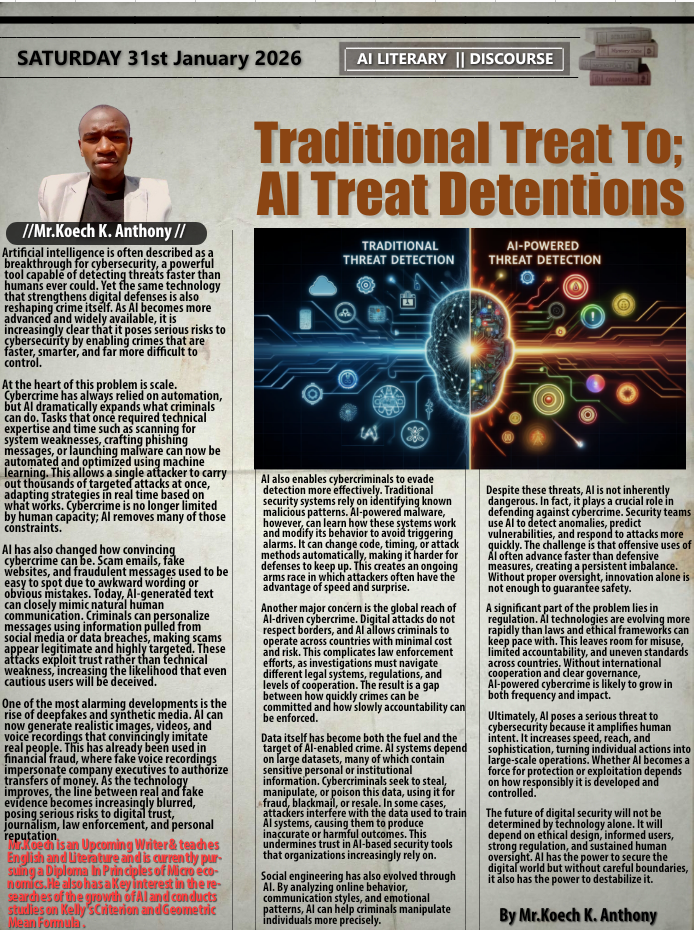
Artificial intelligence is not arriving all at once. It is entering society quietly, through everyday systems people already rely on. Recommendation engines shape what individuals read and watch. Automated systems influence customer service, logistics, and financial decisions. In many places, AI does not announce itself as a revolution; it blends into routine. This gradual integration makes its long-term impact more subtle, but also more significant.
The future of AI will be defined less by dramatic breakthroughs and more by ordinary choices. Decisions made by governments, companies, educators, and communities will determine whether intelligent systems expand opportunity or reinforce existing divides. Technology alone does not shape society. The frameworks surrounding it do.
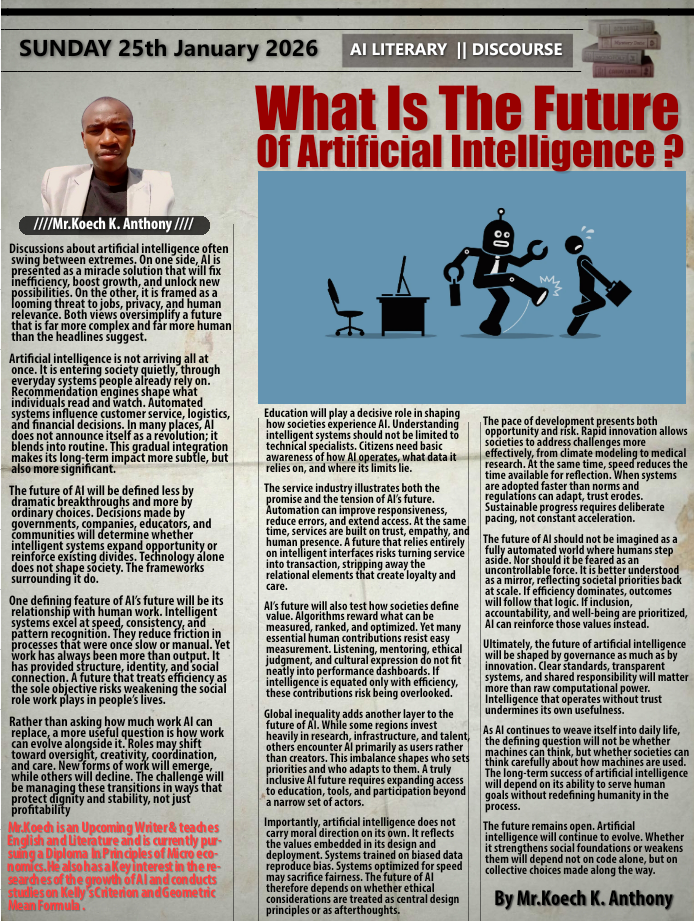
One defining feature of AI’s future will be its relationship with human work. Intelligent systems excel at speed, consistency, and pattern recognition. They reduce friction in processes that were once slow or manual. Yet work has always been more than output. It has provided structure, identity, and social connection. A future that treats efficiency as the sole objective risks weakening the social role work plays in people’s lives.
Rather than asking how much work AI can replace, a more useful question is how work can evolve alongside it. Roles may shift toward oversight, creativity, coordination, and care. New forms of work will emerge, while others will decline. The challenge will be managing these transitions in ways that protect dignity and stability, not just profitability.
Another critical dimension of AI’s future lies in decision-making power. As systems take on greater responsibility in areas such as healthcare, finance, and public services, the distance between decision and consequence can widen. When outcomes are generated by automated processes, accountability can become unclear. A future shaped by AI must preserve the ability to question, explain, and correct decisions that affect human lives.
Education will play a decisive role in shaping how societies experience AI. Understanding intelligent systems should not be limited to technical specialists. Citizens need basic awareness of how AI operates, what data it relies on, and where its limits lie. Without this knowledge, people become passive users rather than informed participants in systems that influence their choices.
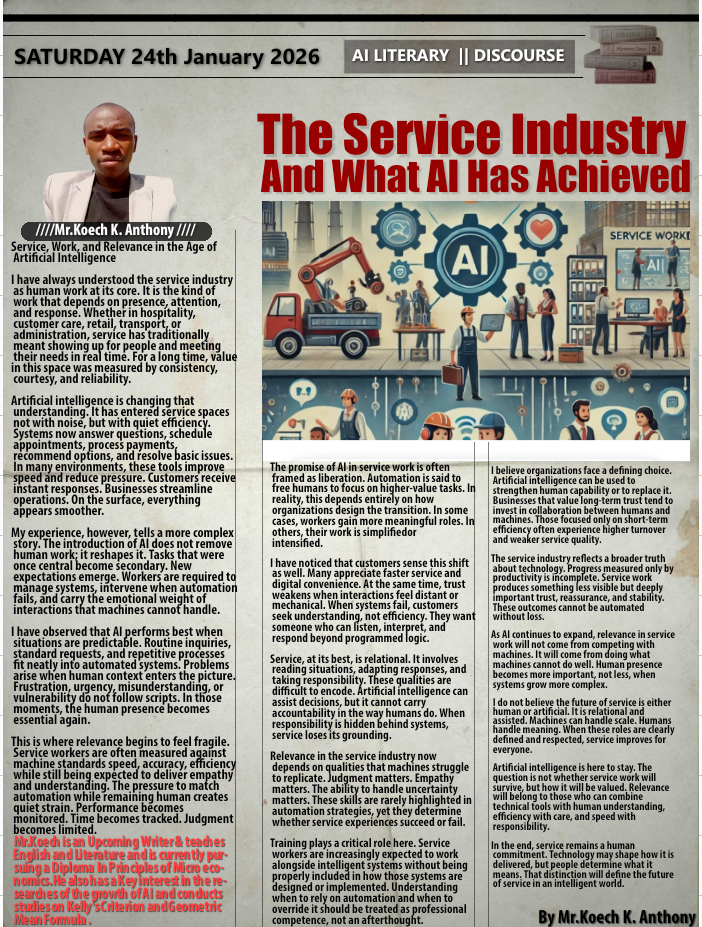
The service industry illustrates both the promise and the tension of AI’s future. Automation can improve responsiveness, reduce errors, and extend access. At the same time, services are built on trust, empathy, and human presence. A future that relies entirely on intelligent interfaces risks turning service into transaction, stripping away the relational elements that create loyalty and care.
AI’s future will also test how societies define value. Algorithms reward what can be measured, ranked, and optimized. Yet many essential human contributions resist easy measurement. Listening, mentoring, ethical judgment, and cultural expression do not fit neatly into performance dashboards. If intelligence is equated only with efficiency, these contributions risk being overlooked.
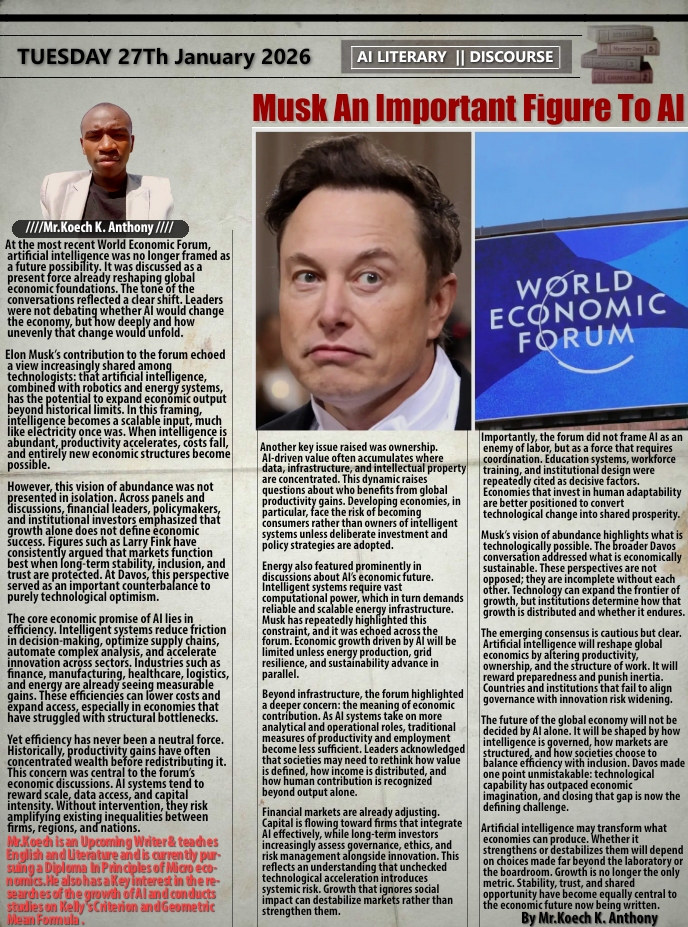
Global inequality adds another layer to the future of AI. While some regions invest heavily in research, infrastructure, and talent, others encounter AI primarily as users rather than creators. This imbalance shapes who sets priorities and who adapts to them. A truly inclusive AI future requires expanding access to education, tools, and participation beyond a narrow set of actors.
Importantly, artificial intelligence does not carry moral direction on its own. It reflects the values embedded in its design and deployment. Systems trained on biased data reproduce bias. Systems optimized for speed may sacrifice fairness. The future of AI therefore depends on whether ethical considerations are treated as central design principles or as afterthoughts.
The pace of development presents both opportunity and risk. Rapid innovation allows societies to address challenges more effectively, from climate modeling to medical research. At the same time, speed reduces the time available for reflection. When systems are adopted faster than norms and regulations can adapt, trust erodes. Sustainable progress requires deliberate pacing, not constant acceleration.
The future of AI should not be imagined as a fully automated world where humans step aside. Nor should it be feared as an uncontrollable force. It is better understood as a mirror, reflecting societal priorities back at scale. If efficiency dominates, outcomes will follow that logic. If inclusion, accountability, and well-being are prioritized, AI can reinforce those values instead.
Ultimately, the future of artificial intelligence will be shaped by governance as much as by innovation. Clear standards, transparent systems, and shared responsibility will matter more than raw computational power. Intelligence that operates without trust undermines its own usefulness.
As AI continues to weave itself into daily life, the defining question will not be whether machines can think, but whether societies can think carefully about how machines are used. The long-term success of artificial intelligence will depend on its ability to serve human goals without redefining humanity in the process.
The future remains open. Artificial intelligence will continue to evolve. Whether it strengthens social foundations or weakens them will depend not on code alone, but on collective choices made along the way.
Discussions about artificial intelligence often swing between extremes. On one side, AI is presented as a miracle solution that will fix inefficiency, boost growth, and unlock new possibilities. On the other, it is framed as a looming threat to jobs, privacy, and human relevance. Both views oversimplify a future that is far more complex and far more human than the headlines suggest.
Artificial intelligence is not arriving all at once. It is entering society quietly, through everyday systems people already rely on. Recommendation engines shape what individuals read and watch. Automated systems influence customer service, logistics, and financial decisions. In many places, AI does not announce itself as a revolution; it blends into routine. This gradual integration makes its long-term impact more subtle, but also more significant.
The future of AI will be defined less by dramatic breakthroughs and more by ordinary choices. Decisions made by governments, companies, educators, and communities will determine whether intelligent systems expand opportunity or reinforce existing divides. Technology alone does not shape society. The frameworks surrounding it do.
One defining feature of AI’s future will be its relationship with human work. Intelligent systems excel at speed, consistency, and pattern recognition. They reduce friction in processes that were once slow or manual. Yet work has always been more than output. It has provided structure, identity, and social connection. A future that treats efficiency as the sole objective risks weakening the social role work plays in people’s lives.
Rather than asking how much work AI can replace, a more useful question is how work can evolve alongside it. Roles may shift toward oversight, creativity, coordination, and care. New forms of work will emerge, while others will decline. The challenge will be managing these transitions in ways that protect dignity and stability, not just profitability.
Another critical dimension of AI’s future lies in decision-making power. As systems take on greater responsibility in areas such as healthcare, finance, and public services, the distance between decision and consequence can widen. When outcomes are generated by automated processes, accountability can become unclear. A future shaped by AI must preserve the ability to question, explain, and correct decisions that affect human lives.
Education will play a decisive role in shaping how societies experience AI. Understanding intelligent systems should not be limited to technical specialists. Citizens need basic awareness of how AI operates, what data it relies on, and where its limits lie. Without this knowledge, people become passive users rather than informed participants in systems that influence their choices.
The service industry illustrates both the promise and the tension of AI’s future. Automation can improve responsiveness, reduce errors, and extend access. At the same time, services are built on trust, empathy, and human presence. A future that relies entirely on intelligent interfaces risks turning service into transaction, stripping away the relational elements that create loyalty and care.
AI’s future will also test how societies define value. Algorithms reward what can be measured, ranked, and optimized. Yet many essential human contributions resist easy measurement. Listening, mentoring, ethical judgment, and cultural expression do not fit neatly into performance dashboards. If intelligence is equated only with efficiency, these contributions risk being overlooked.
Global inequality adds another layer to the future of AI. While some regions invest heavily in research, infrastructure, and talent, others encounter AI primarily as users rather than creators. This imbalance shapes who sets priorities and who adapts to them. A truly inclusive AI future requires expanding access to education, tools, and participation beyond a narrow set of actors.
Importantly, artificial intelligence does not carry moral direction on its own. It reflects the values embedded in its design and deployment. Systems trained on biased data reproduce bias. Systems optimized for speed may sacrifice fairness. The future of AI therefore depends on whether ethical considerations are treated as central design principles or as afterthoughts.
The pace of development presents both opportunity and risk. Rapid innovation allows societies to address challenges more effectively, from climate modeling to medical research. At the same time, speed reduces the time available for reflection. When systems are adopted faster than norms and regulations can adapt, trust erodes. Sustainable progress requires deliberate pacing, not constant acceleration.
The future of AI should not be imagined as a fully automated world where humans step aside. Nor should it be feared as an uncontrollable force. It is better understood as a mirror, reflecting societal priorities back at scale. If efficiency dominates, outcomes will follow that logic. If inclusion, accountability, and well-being are prioritized, AI can reinforce those values instead.
Ultimately, the future of artificial intelligence will be shaped by governance as much as by innovation. Clear standards, transparent systems, and shared responsibility will matter more than raw computational power. Intelligence that operates without trust undermines its own usefulness.
As AI continues to weave itself into daily life, the defining question will not be whether machines can think, but whether societies can think carefully about how machines are used. The long-term success of artificial intelligence will depend on its ability to serve human goals without redefining humanity in the process.
The future remains open. Artificial intelligence will continue to evolve. Whether it strengthens social foundations or weakens them will depend not on code alone, but on collective choices made along the way.